Family-Owned Since 2003

A furnace filter might be small, but it plays a big role in your home’s comfort, air quality and heating efficiency. Using the wrong filters or failing to replace them as necessary leads to poor air quality, higher energy bills and potential system damage.
Furnace filters protect your unit investment and keep your family breathing cleaner air. Explore tips for choosing the right filter type, size and minimum efficiency reporting value (MERV) rating for your home and guidance for when to replace it.
Your furnace filter serves as the first line of defense for both your HVAC system and your home’s air quality. Your filter traps dust, debris and pet dander before these particles enter your system, preventing buildup on the blower motor, heat exchanger and other internal components. This protection reduces wear and tear while extending your equipment’s lifespan.
A study found that HEPA filters reduced fine particulate matter by 39.9% in indoor environments, demonstrating the significant impact proper filtration has on capturing allergens like pollen, dust mites and mold spores.
Clean filters also directly affect your energy bills through increased efficiency. What happens if you don’t change your furnace filter? It becomes clogged, restricting airflow and forcing your system to work harder and run longer to reach the desired temperature. This increased energy consumption translates to higher utility bills.
Minimum efficiency reporting value ratings help you understand how effectively a filter captures airborne particles. Choosing the right MERV rating for your home balances air quality needs with system compatibility.
This standard was developed by the American Society of Heating, Refrigerating, and Air-Conditioning Engineers (ASHRAE). The MERV scale ranges from 1 to 20. Higher numbers indicate finer filtration, such as that provided by high-efficiency particulate air (HEPA) filters.
Here’s how MERV ratings break down:
A MERV rating between 5 and 8 is typical for most residential homes. While ASHRAE recommends MERV 13 or higher for residential use, many furnace systems can’t handle filters with such high ratings without experiencing airflow restriction.
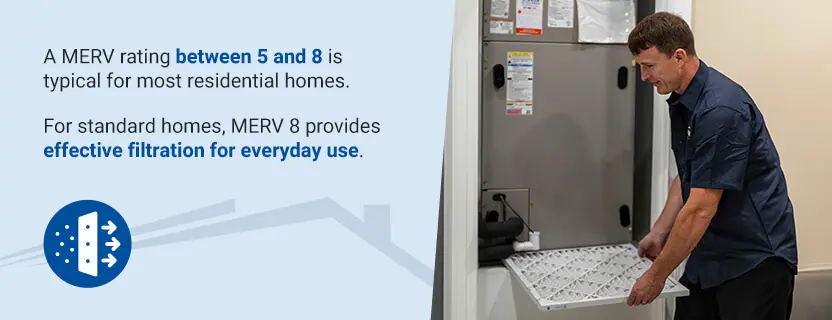
For standard homes, MERV 8 provides effective filtration for everyday use. Higher MERV ratings mean thicker filters, which can restrict airflow more than lower-rated options. If your system isn’t designed to handle a high-MERV filter, it can strain the blower motor, leading to higher energy bills and reduced efficiency. Conversely, a MERV rating that’s too low leaves your system vulnerable to dust and dirt buildup.
The key is finding the balance between your air quality needs and your system’s compatibility. When in doubt, consult a professional technician.
Different filter types vary in levels of filtration, durability and cost. Consider the following to choose the best furnace filter for allergies, your budget and system requirements:
Follow these steps for selecting the right furnace filter:
Most filters should be replaced every three months. Furnace filter replacement frequency depends on the filter type, household conditions and system usage. For example, the following may call for more frequent filter changes:
Watch for warning signs such as visible dirt or discoloration, reduced airflow from vents, systems running longer to reach temperature and higher energy bills. More dust on surfaces throughout your home also signals that your filter is no longer capturing particles effectively.
At Strada Services, our professional technicians take the guesswork out of furnace filter care. During regular maintenance visits, our experienced technicians replace your filter with the right type for your system and household needs. We also provide expert consultations on filter selection, helping you understand which MERV rating and filter material is best for you.
When you work with us, you gain access to experienced technicians, convenient online scheduling and family-owned expertise with a commitment to personalized service since 2003. Our regular maintenance plans include filter checks and replacements, so you never have to worry about forgetting. We make maintaining a healthy home simple.
Ready to get started? Schedule a maintenance appointment from Strada Services today.



 Pay Online