Many states get hot and humid in the summer, making days and nights uncomfortable without a reliable air conditioning solution to cool your space down. HVAC systems should be installed in the right locations to work efficiently. This is a crucial decision that ultimately impacts the system’s energy consumption, efficiency and lifespan.
So, what is the ideal placement for an air conditioner for the best cooling? This guide offers practical tips on selecting the best location for your HVAC system.
It’s important to get your HVAC system location right because where you place it has a direct impact on performance, energy efficiency, durability and overall maintenance cost. Incorrect placement may lead to a number of problems, like frequent repairs and replacements, which undermine the system’s performance and longevity.
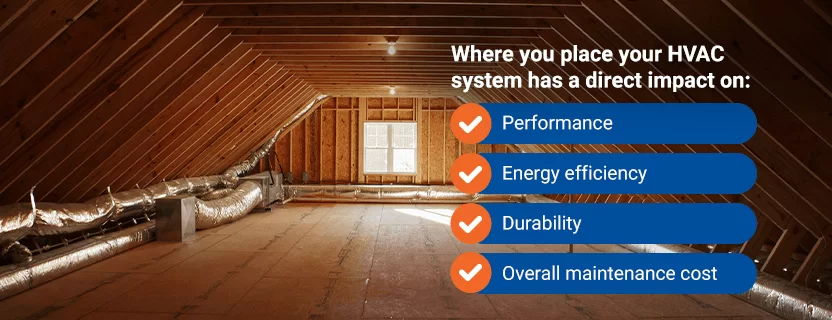
Studies indicate that HVAC systems account for approximately 40% of a building’s total energy consumption. Poor placement of the air conditioning unit can make it work harder than necessary to meet the required temperature demands. By installing the system in a proper location, you can:
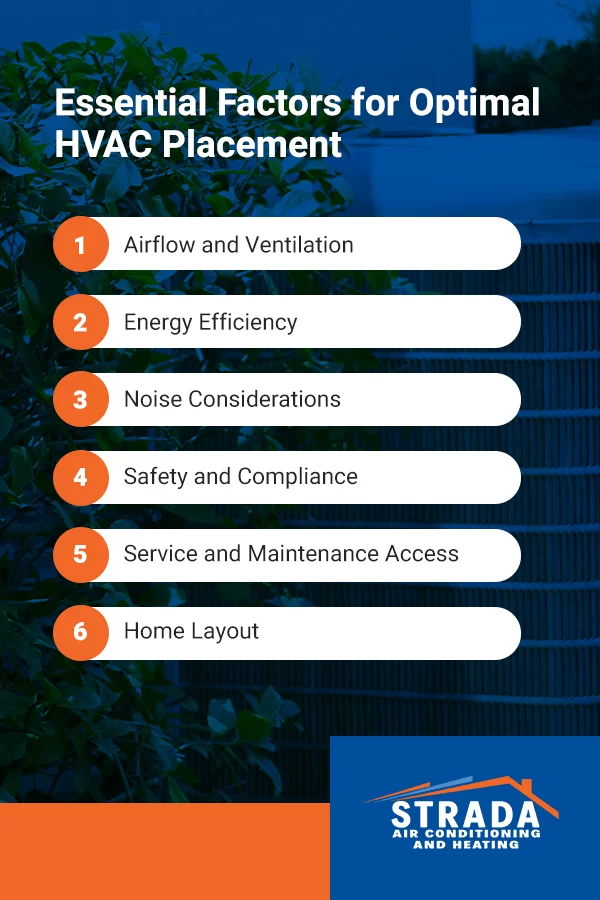
Choosing the right location for installing an HVAC system is essential, as it affects the solution’s effectiveness and your wallet. Here are key factors to consider when selecting the location of your HVAC unit:
Proper airflow is the foundation of HVAC performance. Both outdoor and indoor units require sufficient air circulation, free of obstructions, to operate effectively. It’s important to place indoor units where routing ductwork doesn’t face challenges such as excessive bends, long runs and other restrictions.
Poor airflow increases the blower motor’s workload, reducing comfort and potentially causing uneven cold spots throughout the home. Outdoor units should have adequate clearance on all sides to allow heat to dissipate freely. Any type of obstruction can trap heat and push the system to work harder.
Where you install your HVAC system directly affects how much energy it consumes. Picking a location that supports shorter duct runs and refrigerant lines can help lower energy loss and help maintain consistent temperatures. Indoor units placed in a central location within the home tend to distribute air more evenly, improving efficiency.
Outdoor units placed in well-ventilated areas — ideally in partial shade — maintain air distribution better than those exposed to direct sunlight. In addition, placement affects thermostat accuracy. If the thermostat is close to disruptive factors, such as supply vents, exterior vents, or heat-producing appliances, it’s likely to misread temperatures, and that causes the system to cycle inefficiently.
HVAC systems generate noise during normal operation. The noise comes from fan movement, compressor cycling and airflow. Strategic placement can help conceal some of that sound in the spaces your household frequents.
You’ll want to place indoor equipment away from quiet spaces whenever possible. Utility rooms and insulated closets are best at containing the sound. Keeping outdoor units away from windows, patios and neighboring properties also reduces noise disturbance.
Another strategy to reduce noise transfer through structures is to control vibrations. Ensure the unit is free of debris, its parts are tightened and consider getting rubber isolation pads for underneath the unit if necessary.
Safety is a critical factor in HVAC placement. Indoor units must be in areas where proper clearances and ventilation are possible and in line with local building codes. For example, installations in garages should comply with airtight requirements, while attic and crawl spaces should comply with moisture control and structural support standards.
For outdoor units, keep in mind flooding, debris and snow-prone areas. These locations can pose electrical hazards to people and damage to the equipment.
Like any other machine, HVAC systems need regular maintenance. You must prioritize proactive repairs and replacements to maximize your investment and keep your system running at its best. The unit’s location should allow technicians easy access.
Units squeezed into tight areas, such as hard-to-reach attics and cramped crawl spaces, can complicate maintenance. In addition, these challenging environments accelerate wear and subsequent costs. You need clear access and sufficient working space to ensure proper servicing.
Every home is different, and HVAC placement should also reflect the layout and usage demands of the available space. An installation that aligns with the home’s unique architectural design and daily use patterns allows the system to serve its purpose more effectively, rather than working against the building’s structure.
For instance, in multi-story homes, strategic placement often involves considering separate units or a meticulously designed zoning system to manage temperature differences between floors. Heat naturally rises, making upper floors warmer. Placing an indoor unit in the attic can be advantageous for cooling upper levels directly, while a unit in a utility closet on a lower floor can more effectively serve the ground level. The goal is to minimize the travel distance of conditioned air, reducing heat gain or loss within ductwork and ensuring consistent temperatures across all levels.
Open floor plans, popular in modern design, present their own set of challenges. While they promote a sense of spaciousness, they can also make it harder to evenly distribute conditioned air, leading to noticeable drafts or hot and cold spots.
Central placement of the indoor unit, combined with well-designed ductwork and strategically located registers, becomes paramount. The system needs to be powerful enough to circulate air across large, uninterrupted spaces, yet gentle enough to maintain comfort. Thermostat placement in these layouts is also critical, ideally situated in a central, high-traffic area that represents the average temperature of the entire zone.
When installing an HVAC system indoors, the location directly affects functionality and comfort. As you select the right location for major components, your placement decision also factors in airflow patterns — an important consideration in determining the best place to put a thermostat in the home for accurate temperature readings.
Attics are an excellent choice for AC installation. Especially in regions like Florida, where climate and soil conditions often mean homes lack basements, attics are often the primary location for HVAC systems.
Placing your AC unit in the attic offers several benefits. It frees up valuable living space and keeps the equipment discreetly out of sight. Attic-based systems are ideally positioned to cool upper-level zones, simplifying zoning and reducing the need for extensive ductwork to reach these rooms.
However, attics also present challenges. Extreme temperatures can reduce the system’s efficiency, and limited access can make maintenance and repairs more difficult. There’s also an increased risk of condensation issues, leaks, and potential ceiling damage.
Utility closets are dedicated spaces in a home for housing electrical equipment, such as HVAC systems. Some homes also have crawl spaces, which can be great places to keep certain HVAC components. Whether you’re considering a dedicated utility space or a crawl space, each has pros and cons.
Both often provide a central placement within the home, which is ideal for efficient duct routing. Proper design allows the setup to deliver consistent comfort while minimizing duct length.
However, tight spaces may limit access, making servicing more challenging. Crawl spaces also require robust construction, moisture control and insulation. Noise transfer is also likely to be an issue if the utility space is not sufficient.
Hallways are often used to house HVAC components when there isn’t enough space for a dedicated mechanical room. In well-planned homes where space efficiency and balanced airflow are a priority, hallways are ideal.
Some of the advantages of placing your AC in a hallway include:
Without sufficient sound insulation, noise and vibrations may be noticeable. Installing AC units in hallways requires proper planning to maintain clearance and airflow. If not well-planned, installation may reduce usable hallway space.
Garages are a common, practical solution for HVAC systems, but they generally need careful planning to ensure safety, efficiency and code compliance. Since garages are usually connected to living spaces, local building codes tend to impose strict requirements for any adjustments to avoid compromising indoor air quality. That said, garages offer an excellent location for HVAC placement.
Garages offer several benefits for HVAC system placement. They typically provide ample service access, making maintenance work easier and less disruptive due to the additional space around the unit. Furthermore, utilizing the garage maintains interior storage and living space, presenting a viable option for homes without basements or other dedicated mechanical areas.
However, high temperatures in unconditioned garages can significantly reduce system efficiency during hot summers. Strict local building codes for garage construction, including guidelines on elevation, venting methods and vehicle clearance, can affect HVAC system installation.
To determine the best location for installing an outdoor HVAC unit, here are important considerations and how each affects performance.
HVAC units generate heat as they operate. As such, maintaining ambient temperature is key to ensuring overall efficiency. Units placed in the shade outperform those exposed to direct sunlight all day because the cooler surrounding air helps the system release heat. If exposed, the system will struggle to dissipate heat effectively, which can strain the compressor.
While avoiding direct sunlight or heat sources is important, you should also consider how shade affects airflow. Placing a unit under structures can trap heat and limit air circulation. You want a shade that still allows open air circulation around the unit.
The outdoor unit, which houses the compressor, needs enough space on all sides to pull in air and expel heat. Without proper clearance, your HVAC system will not have adequate room to operate safely. Poor clearance can strain equipment, leading to frequent maintenance issues. The amount of clearance you need may vary from one manufacturer to another.
However, you typically need to prepare at least two feet of space on all sides of the unit and five feet or more above the unit.
You must consider obstructions, such as walls, fences, pillars and shrubs, which can restrict airflow. Prioritize proper clearance around your unit at all times.
It’s important that the outdoor HVAC unit sits on a solid, level foundation. A stable and level surface prevents vibrations, reduces noise and keeps internal components from shifting and risking damage. Reliable options such as concrete pads, composite pads and elevated brackets provide an even surface and raise the unit above runoffs and pooled water levels.
Uneven or sinking pads can cause refrigerant issues and excessive wear on moving parts. Take into account challenges like soft soil to ensure pads remain level and secure before and after installation.
Besides runoffs, downspouts and irrigation systems, outdoor HVAC placement should also take into account internal drainage issues. The HVAC system has a condensate drain line that removes condensate — moisture left behind during the cooling cycle. During operation, water droplets form on the evaporator coils as warm air passes over them. The water continuously collects and drains out the condensate drain line.
With the outdoor unit, factor in both the internal and external water sources. Ensure proper condensate drainage while accounting for rainwater, which can damage equipment or cause soil erosion beneath the supporting pad.
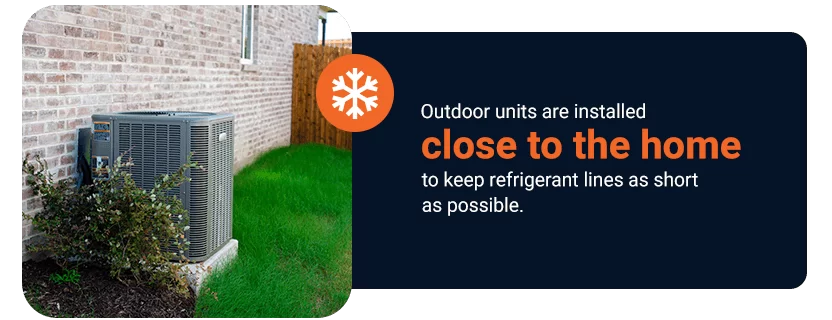
How far should an HVAC unit be from the house? This is a common question, and the answer depends on various factors, such as manufacturer guidelines and installation best practices. In general, however, outdoor units are installed close to the home to keep refrigerant lines as short as possible.
Shorter lines offer several benefits, such as:
While outdoor units shouldn’t sit directly against the house due to clearance requirements, keeping them close to the indoor air handler is important.
Do you want to install a new HVAC system or replace an old unit? Whatever your needs are, we at Strada Air Conditioning & Heating are here to help. We understand the pressure of selecting the right position for an HVAC system and will provide expert guidance. Your comfort is our top priority. We will help you determine the right placement and install an HVAC system that operates at peak efficiency.
Schedule an appointment to discuss your needs with an expert.


Joe Strada, owner of Strada Electric, Security & Air Conditioning, started working at the young age of 14. He’s never attended college, but he has spent his life dedicating his time and energy to his trade and providing high-quality services to his customers. At 19, Joe started working at a well-known air conditioning company and developing his commitment to excellence. He has state certifications in electric, plumbing, air conditioning, residential building and general contracting. During his years of training and experience, Joe noticed a sincere need for a dependable electrical contractor in Florida who embodied the same dedication to customer service in which he believed. In 2003, Joe co-founded Strada Electric, Security & Air Conditioning. Since then, the company has been in the business of providing peace of mind to customers. We offer expert electric, security and air conditioning solutions for homes and businesses, leveraging our experience to deliver professional and responsive service with reliability and respect.