Family-Owned Since 2003
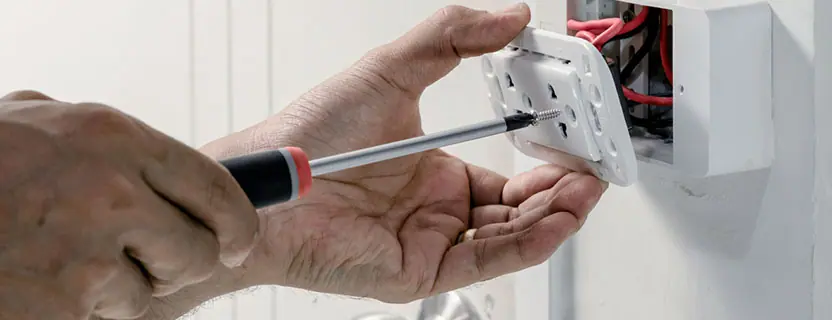
When you experience electrical problems in your home, you’ll probably want to resolve them as soon as you can. In 2023, there were 23,700 residential fires in the United States, resulting in over $1.5 billion in damages. Many of these fires may have been caused by simple and easily solved problems.
While it isn’t always possible for you to solve electrical problems on your own, you can often fix common electrical issues quickly and safely, without any professional help.
To troubleshoot common electrical issues, you need to know how to identify and safely solve them. This involves recognizing common signs of electrical problems in your home and finding the root cause.
Overlamping is when a light fixture has a light bulb that has a wattage higher than the fixture was designed for. It can cause the bulb to become too hot and scorch or melt the light socket, and perhaps burn wiring. In a worst-case scenario, overlamping can cause arc faults. Arcing is when electricity jumps from one conductor to another, shocking people who are near but not necessarily in contact with the device.
To avoid overlamping, check the recommended wattage of a light fixture before fitting it with a suitable bulb. If you find a light bulb fitted into a device with the incorrect wattage capabilities, replace the bulb before you use it again.
A fuse is a safety feature found in electrical circuits to prevent dangerous levels of current from flowing through it. When too much current flows through the fuse, it melts and breaks the circuit. Signs of a blown fuse include burn marks on the fuse and a loss of power. A blown fuse could also trip circuit breakers in your home to protect other circuits.
Various problems can cause a blown fuse, such as:
It’s easy to replace a blown fuse, and often, this will resolve the problem. However, if you find that fuses are blowing fairly regularly, it could be a sign of a more extensive and ongoing problem.
While simple in nature, having too few electrical outlets can create a fire hazard. This is because the typical solution is to use extension cords, but if your cord can’t handle the required amperage or wattage, it can become overburdened, overheat and ignite. If your extension cord feels hot, becomes discolored or circuit breakers trip when you use it, it may be unsafe to use.
To prevent this, only use extension cords with the required rating to handle your devices. Alternatively, have an electrician install additional outlets.
While lights can flicker for various reasons, if it only happens when it’s windy outside, it can point to a problem with your weatherhead — the outdoor fitting that connects to power lines and delivers power to your home. If wires in your weatherhead are damaged, windy weather can move those wires and cause fluctuations in power delivery.
If you suspect your weatherhead is damaged, contact your electrical supplier first, then get in touch with a trusted local electrician if necessary.
Faulty wiring is a common electrical problem in older homes that may be overdue for a rewire. When wires are frayed, exposed or otherwise damaged, it can cause various electrical issues, such as intermittent power supply and blown fuses. Other signs of faulty wiring include:
If you believe you have faulty wiring in your home, there’s very little you can do yourself. Rewiring a house is something a qualified electrician should do, so get in touch with a professional as soon as possible.
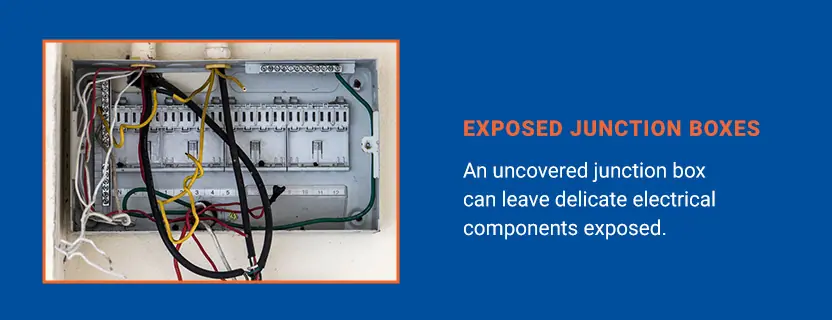
An uncovered junction box can leave delicate electrical components exposed. These components could be knocked or come into contact with moisture and dust, causing damage and increasing the risk of a shock or faulty operation.
To fix this issue, cover the junction box. If you’ve lost the cover to your junction box, you should easily be able to buy a replacement.
Ground-fault circuit interrupters (GFCIs) are a safety feature that can significantly reduce the likelihood of a shock in wet areas. However, many older outlets don’t have this simple feature. While GFCIs don’t affect how well your outlets work, they can make them much safer to use in your kitchen, bathrooms and any other areas of your home that may get wet.
To check if your outlets are GFCI outlets, look for “test” or “reset” buttons. If your outlet has these buttons, it’s a GFCI outlet.
If you don’t have GFCI outlets, it’s easy to replace your outdated outlets yourself, or you can hire a professional electrician to do this for you.
While aluminum wiring hasn’t been used since the ’70s, many older houses that haven’t been rewired may still have it. Used as a cheaper alternative to copper, aluminum wiring is now known to be dangerous. It can corrode when it comes into contact with copper, causing arcing and fires.
To reduce this risk, fit a dialectric wire nut that’s suitable for aluminum wire onto any connection that uses both copper and aluminum. For complete peace of mind, consider calling a professional to rewire your home completely.
When you’re troubleshooting common electrical issues, identifying the cause of the problem is the first step to solving it. If your appliance stops working suddenly and it’s not immediately obvious why, follow these steps:
However old your home is, there are many electrical problems that it could experience. Often, it’s possible to troubleshoot home electrical issues safely, but some problems will require expert knowledge to resolve.
At Strada Services, we’ve been delivering this expertise to our customers across the Southern United States for over two decades. Whether you need a simple repair or a complete rewire, our friendly team can help by delivering professional electrical repair services.
To find out more about our electrical services, get in touch with us today.

Joe Strada, owner of Strada Electric, Security & Air Conditioning, started working at the young age of 14. He’s never attended college, but he has spent his life dedicating his time and energy to his trade and providing high-quality services to his customers. At 19, Joe started working at a well-known air conditioning company and developing his commitment to excellence. He has state certifications in electric, plumbing, air conditioning, residential building and general contracting. During his years of training and experience, Joe noticed a sincere need for a dependable electrical contractor in Florida who embodied the same dedication to customer service in which he believed. In 2003, Joe co-founded Strada Electric, Security & Air Conditioning. Since then, the company has been in the business of providing peace of mind to customers. We offer expert electric, security and air conditioning solutions for homes and businesses, leveraging our experience to deliver professional and responsive service with reliability and respect.



 Pay Online