Family-Owned Since 2003
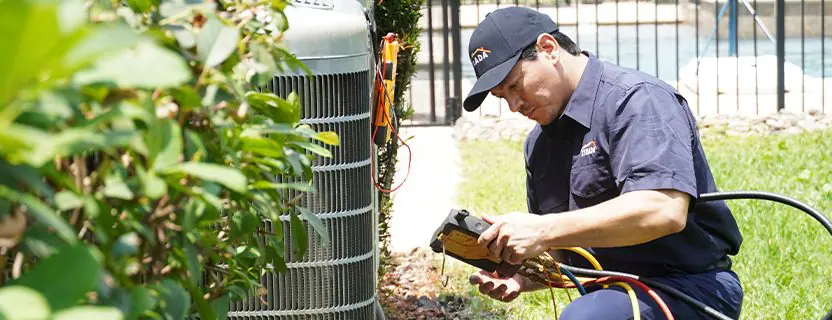
An air conditioner can turn on and push out cool air, yet be past its prime. This makes it difficult to diagnose significant issues, since most of the time you’re not looking at a big, obvious failure. You are seeing a gradual drop in performance, which is a common symptom of an aging air conditioner losing efficiency.
Most central air conditioning systems last at least a decade when properly installed and well-maintained. When your AC works extremely hard all season long, it’s likely to get there sooner.
If any of the symptoms below feel familiar, it’s often a sign your AC unit is aging and toward the end of its useful life. Once a system crosses that threshold, repairs become more frequent, efficiency drops and replacement starts to make more financial sense than continuing to patch an aging unit.
If you didn’t install the system yourself and don’t have paperwork from when it was put in, there are a few straightforward ways to find out how old it is.
The most reliable method is to check the data plate on the outdoor condenser unit. This is a metal label, usually on the side of the unit, that lists the manufacturer, model number and serial number. Most manufacturers encode the production date directly into the serial number. Often, the first four digits represent the week and year of manufacture, though the format varies by brand. If you search the manufacturer’s name along with “serial number date lookup,” you can usually decode it in a few minutes.
Your home inspection report is another good source if you bought the house relatively recently. Inspectors typically note the age and condition of major systems. Service records, if you have them, will also show installation and repair dates.
If you find that the system uses R-22 refrigerant, that alone is a reliable indicator that the unit is at least 15 years old, since R-22 systems stopped being manufactured years ago.
Once you have a rough sense of the system’s age, the signs below can help you decide whether replacement makes sense.
The following signs are worth paying attention to, as they often indicate a unit that is declining rather than dealing with a one-off problem.
If your cooling unit uses R-22, often called Freon, it is almost always an older unit. In many cases, it’s at least 15 years old or more.
New R-22 systems stopped being made years ago, and production of R-22 itself ended in 2020. A recharge now requires reclaimed refrigerant, which is significantly more expensive. If you are paying a considerable amount each season to keep the system running on R-22, you are spending money on a unit that is well past its expected lifespan.
Aging systems will often cool, but not evenly. Maybe one bedroom never really cools down at night, and the living room gets stuffy every afternoon. You might also notice that the upstairs always feels warmer than downstairs. So you drop the thermostat to make one stubborn area bearable, and the rest of the house ends up colder than you want.
Start with the obvious. A professional can help you clean the filter, open the vents and clean the outdoor unit. If those are fine and it still cannot keep up, an older unit may simply be losing capacity. Coils and compressors wear out over time, and airflow drops. The AC runs, but it is no longer doing the job it was designed to do.
Sometimes the thermostat number looks fine, but the house still feels wrong.
If the air feels sticky or heavy, the air conditioning might not be pulling out moisture like it used to. A healthy AC should cool and dehumidify at the same time. When that starts to slip, the house can feel uncomfortable even at a sensible setting. If you are experiencing persistent humidity alongside long run times and uneven cooling, these symptoms together are a strong sign that an aging system is no longer performing as it should, and replacement is worth considering.
Unusually high bills are one of the easiest signs to spot.
If summer electricity costs have risen over the past few years and nothing major has changed in how you use the AC, the unit is probably working harder to do the same job. Motors could have worn down and struggled to shift heat.
You can rule out the simple issues first, replace the filter and clear space around the outdoor condenser. If the unit is 10 years old or older and bills keep creeping up anyway, the cost is often being driven by age rather than anything that a quick fix can solve.
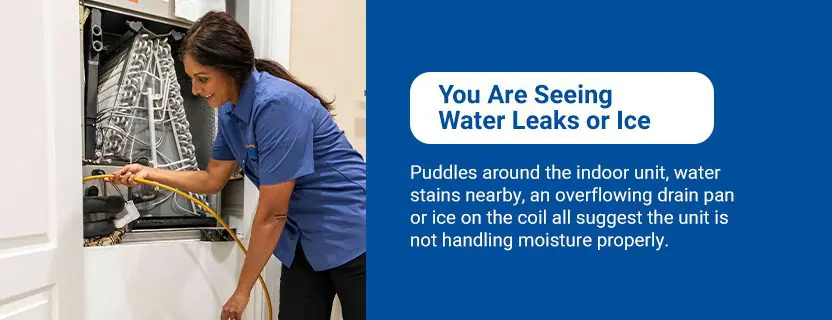
A small amount of condensation at the drain line is normal, but the water you can see on the floor is not.
Puddles around the indoor unit, water stains nearby, an overflowing drain pan or ice on the coil all suggest the unit is not handling moisture properly. Sometimes the fix is simple, like clearing a drain line. But if it keeps happening on a well-used unit, it often suggests the cooling equipment is not running as cleanly as it should.
Sometimes you notice the house feeling stuffy, dust building up faster or the air being damp even when the temperature is set low. The AC runs, but the space does not feel fresh.
Filters and ductwork play a key role here. But if you change these regularly and the ductwork is in decent condition, a noticeable shift in air quality often comes down to the unit’s age.
An occasional repair is normal. A pattern is not.
Think back over the last three to five summers. If you have needed a call-out most years or more than once in the same season, that is different. It most likely means the AC is wearing out rather than dealing with one-off problems.
What you are fixing matters, too. A simple capacitor replacement is one thing. Repeated refrigerant leaks, coil issues, compressor problems or wiring faults are significant issues. When those bigger repairs start appearing on an aging unit, replacement is often the better call.
Most people know how their AC sounds when it is healthy. So when it changes, it stands out.
Grinding, squealing, rattling or clanking can mean parts that are wearing out or something inside that is struggling. Smells are a good indicator, too, and a musty odor can suggest moisture buildup. A burning smell can point to wiring trouble or overheating.
Some of these problems can be fixed. But if they show up alongside poor cooling, high bills and frequent repairs, they often mean the system is reaching the end of its run.
Any single symptom can have a simple cause, such as a blocked drain that can leak, a loose panel that can rattle or a dirty filter that can increase energy use. You should replace an old air conditioner when several of these signs show up together, especially on a system that is already 10 to 15 years old.
A good way to move forward is to jot down the age of the system, the issues you have noticed and what you have spent on repairs in recent years. Then ask a qualified AC tech to check it over with repair and replacement on the table. That way, you can make the call before it turns into an emergency.
If a few of the signs above feel familiar, you do not have to guess. Strada Services can take a look at your current AC unit and give you a straight answer on whether it is worth repairing or if replacement will save you money and hassle. Our team will walk you through your options so you know exactly what you are paying for and why. If you do decide to replace your unit, we can help you choose a system that fits your home and your budget. To speak to our team, call 865-350-7051 or schedule an appointment online.


Joe Strada, owner of Strada Electric, Security & Air Conditioning, started working at the young age of 14. He’s never attended college, but he has spent his life dedicating his time and energy to his trade and providing high-quality services to his customers. At 19, Joe started working at a well-known air conditioning company and developing his commitment to excellence. He has state certifications in electric, plumbing, air conditioning, residential building and general contracting. During his years of training and experience, Joe noticed a sincere need for a dependable electrical contractor in Florida who embodied the same dedication to customer service in which he believed. In 2003, Joe co-founded Strada Electric, Security & Air Conditioning. Since then, the company has been in the business of providing peace of mind to customers. We offer expert electric, security and air conditioning solutions for homes and businesses, leveraging our experience to deliver professional and responsive service with reliability and respect.

 Pay Online